
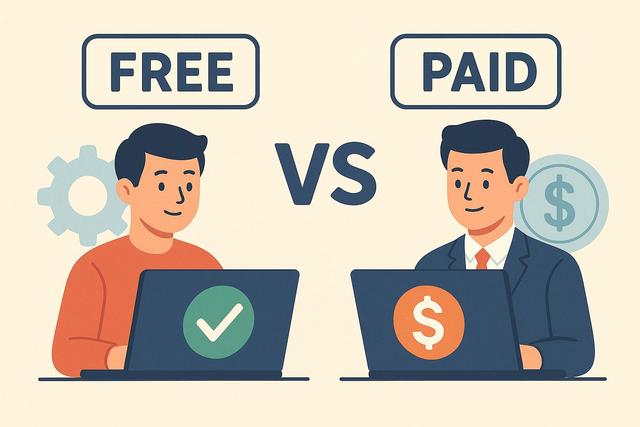
Choosing Between Free and Paid Software
Should you choose free software or paid software? This question often arises for both personal and professional use. Behind this choice lie significant differences in terms of features, security, support, and actual costs. In this article, you will find a simple and clear comparison to help you select the solution that best meets your needs.
Download the Latest Version of Microsoft Office
For those interested, you can download the latest version of Microsoft Office here.
Understanding Search Intent
When comparing free software to paid software, we generally want to know which option offers the best cost-effectiveness. The goal is not just to save money. We mainly want to avoid unpleasant surprises, save time, and use a reliable tool.
The main intent of the reader is therefore simple: to choose the most suitable solution for their needs, without unnecessary expenditure and without compromising quality.
What is Free Software?
Free software is a program that you can use without paying for a license. This does not always mean that it is completely free of rights. Some free software remains proprietary, while others are open source.
There are several types of free software:
- 100% free software.
- Open source software.
- Limited free versions (freemium).
The Advantages of Free Software
Free software offers several benefits:
- No purchase cost.
- Quick installation.
- Ideal for testing a solution.
- Accessible to individuals and small organizations.
For instance, to edit images, manage a small budget, or write simple documents, a free tool may suffice.
Additionally, in the case of open source software, the community often contributes to improving the product, fostering innovation and transparency.
The Limits of Free Software
However, free software also has its limitations:
- Restricted functionalities.
- Sometimes intrusive advertisements.
- Limited or nonexistent customer support.
- Irregular updates.
In some cases, the free software mainly serves to attract users to a more complete paid version, known as a freemium model.
What is Paid Software?
Paid software requires the purchase of a license or subscription. In exchange, the publisher typically offers more advanced features and support services.
Today, many paid software products operate on a monthly or annual subscription basis, allowing for regular updates.
The Advantages of Paid Software
Paid software often offers:
- Comprehensive functionalities.
- Responsive customer support.
- Frequent updates.
- Better data security.
For professional use, these elements often make a significant difference. A stable and secure tool avoids considerable time loss, making the cost quickly justifiable.
The Disadvantages of Paid Software
The main disadvantage remains the price. Depending on the tool, the subscription can represent a significant annual expense.
Additionally:
- Some functionalities may remain complex.
- Subscription terms may change.
- There is a risk of vendor lock-in.
It is therefore important to compare offers before committing.
Simple Comparison: Free vs. Paid Software
Here is a summary table to better understand the main differences.
| Criterion | Free Software | Paid Software |
|---|---|---|
| Price | Free | License or subscription |
| Features | Often limited | Comprehensive and advanced |
| Customer Support | Rare or community-based | Dedicated support |
| Advertisement | Possible | Generally absent |
| Security | Variable | Often enhanced |
| Updates | Irregular | Regular |
This table provides an overview. However, each software remains a unique case; thus, it is necessary to analyze your specific needs.
Which Software Should You Choose Based on Your Profile?
The right choice depends on your actual usage.
For Occasional Personal Use
If you use the software sporadically, free software often suffices. For example:
- Simple text editing.
- Basic photo editing.
- Video playback.
- Personal organization.
In this case, you avoid unnecessary expenses.
For a Student
A free software or a discounted educational version may be suitable. Many publishers offer special deals, but these conditions should be verified at the time of purchase.
The key is to have functionalities adapted to the required tasks.
For Freelancers or Small Businesses
Here, the consideration changes. A bug or a technical limitation can slow down your activity. Often, lost time costs more than a subscription.
Paid software generally provides:
- Better stability.
- Quick assistance.
- Tools tailored for productivity.
In this context, the investment becomes strategic.
For Structured Companies
Large companies often prefer paid solutions. They seek security, compliance, and professional support.
However, some companies also integrate open source software to reduce costs, sometimes combining both models.
The Real Cost of Software
It is often thought that free means economical. However, this is not always true.
Free software can lead to:
- A loss of time due to limitations.
- Indirect costs in case of errors.
- Lack of data security.
In contrast, paid software can represent a clear and predictable fixed cost. You know how much you are paying each month or each year.
Therefore, it is essential to analyze the overall cost, not just the listed price.
Security and Data Protection
Security is a major criterion in the choice between free and paid software. Some free tools protect data very well. However, others may lack regular updates.
A paid publisher generally invests more in:
- Data encryption.
- Security patches.
- Compliance with legal standards.
If you handle sensitive data, this aspect becomes a priority.
Free Software, Open Source, and Paid Software: Don't Confuse Them
Many people confuse free software and open source. However, the difference exists.
An open source software allows access to the source code. You can modify it according to its usage conditions. In contrast, proprietary free software does not grant access to the code.
A paid software can also be partially open source. Each model therefore has its specifications.
How to Make the Right Choice?
Here is a simple method for choosing between free and paid software:
- List your essential needs.
- Identify the indispensable functionalities.
- Test a free version if available.
- Evaluate the customer support offered.
- Compare the cost over one year.
Do not rely solely on the price. Analyze the actual value of the tool.
Additionally, always check the current conditions on the official publisher's website, as offers and prices may change.
Conclusion
The choice between free software and paid software primarily depends on your needs, budget, and level of requirement. A free tool is perfectly suitable for simple or occasional use. In contrast, paid software is often necessary for professional or regular use.
Before deciding, analyze the overall cost, features, and quality of support. This way, you will invest in a solution that is truly adapted to your situation.
FAQ
Is free software always less efficient?
No. Some free software offers excellent performance. However, they may limit certain advanced functions.
Does paid software guarantee better security?
Not automatically. However, paid publishers generally invest more in updating and protecting data.
Can you easily switch from free software to paid software?
Yes, especially if the model is freemium. It often just requires activating a subscription to unlock new features.
Should you prioritize a subscription or a one-time purchase?
The subscription often includes regular updates. A one-time purchase may be cheaper in the long run, but it depends on the product's evolution. Check the current conditions before choosing.


