
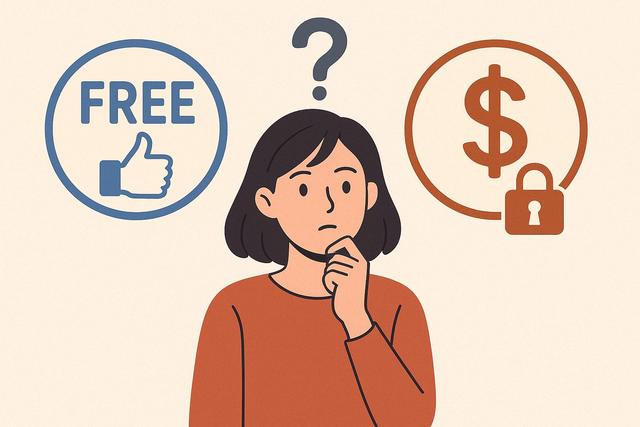
Free vs. Paid: Understanding the Differences
The choice between free and paid options may seem straightforward, but it raises an important question. What is the real difference between a free offer and a paid one? Behind these two terms lie business models, levels of service, and often unseen stakes. In this article, you will understand what truly distinguishes free from paid services and how to make a choice that fits your needs.
Explore Our Recommendations
If you're looking for the latest version of Microsoft Office, you can find it on our download page here.
What is the intent behind the search "free or paid"?
When someone types "free or paid: what is the real difference," they are mostly looking to make a decision. They want to know if a free version is sufficient or if they need to pay for more value.
This question applies to many areas:
- software and applications
- streaming platforms
- online courses
- banking services
- marketing tools
- video games
In all these cases, the dilemma remains the same. Does the free version really meet the need? Or does switching to paid change everything?
To answer this clearly, one must understand the structural differences between free and paid offerings.
How does free really work?
A free offer almost never means that it earns nothing for the company. In reality, the business model differs.
The advertising-funded model
Many free services rely on advertising. The user does not pay in money, but they pay with their attention.
For example:
- videos with advertising breaks
- banners on websites
- targeted ads on social media
In this case, the service remains accessible to everyone. However, the experience may be less comfortable.
The freemium model
The freemium model combines free and paid. A basic version remains free. Advanced features become paid.
This model is widespread in mobile applications and professional software.
The goal is simple:
- Attract a large number of users.
- Convert a portion of them into paying customers.
The free version often serves as a long trial. It allows users to test the product without risk.
Free in exchange for data
Some free services use user data to generate revenue. This data fuels targeted advertising or business analytics.
This does not necessarily imply danger. However, it is essential to check the terms of use and the privacy policy.
The true cost of free can therefore be:
- time
- personal data
- a limited experience
What does a paid offer really provide?
A paid offer changes the relationship between the customer and the service. You no longer indirectly fund the product. You pay directly for a clear benefit.
Better service quality
In many cases, paid services offer:
- less or no advertising
- priority customer support
- more frequent updates
- superior performance
For example, paid software often provides more options, more storage, or more automation.
A financial commitment that changes usage
When you pay, you become more invested. You tend to use the service more seriously.
Additionally, the company directly relies on your satisfaction. If the service doesn't work, you can cancel.
This creates positive pressure on quality.
A generally more transparent model
A paid service is primarily based on subscriptions or direct sales. The business model remains clear: you pay for a service.
This does not guarantee perfection. However, it often reduces dependence on advertising or bulk data exploitation.
Free or paid: what are the concrete differences?
Here is a simple comparison table:
| Criterion | Free | Paid |
|---|---|---|
| Price | €0 for the user | Subscription or one-time purchase |
| Advertising | Often present | Rare or absent |
| Features | Limited | Complete or advanced |
| Customer Support | Basic or nonexistent | Priority or personalized |
| Personal Data | Often used for commercial purposes | Generally less exploited |
| Commitment | Low | Stronger |
Of course, each service varies. Therefore, it is essential to analyze on a case-by-case basis.
Is free really less effective?
Not necessarily.
In some areas, free is more than sufficient. For example:
- reading articles online
- using basic messaging
- slightly editing an image
For occasional use, the difference between free and paid remains minimal.
However, for professional or intensive use, limitations quickly become apparent. Lack of space, technical restrictions, absence of support: these constraints can hinder productivity.
The real question is not "free or paid?". It is rather: "For what use?"
When to choose free?
Free remains relevant in several situations.
Choose free if:
- you are testing a service for the first time
- you have a limited budget
- you use the tool occasionally
- the features offered meet your needs
Free allows you to explore without risk. It also serves as a temporary solution.
However, be aware of hidden limits. Some platforms restrict data export or access to certain important options.
When is it better to pay?
Switching to paid becomes relevant when the service plays an important role in your activity.
Pay if:
- you use the tool daily
- your activity relies on its performance
- you need quick support
- data security is a priority
For example, an entrepreneur may start with a free tool. But as their business grows, they save time with the advanced features of a paid version.
The cost then becomes an investment.
The false free and hidden costs
Some offers appear free but include indirect costs.
Here are some examples:
- in-app purchases in games
- features blocked after signup
- strong limitations after a few uses
In these cases, users quickly find themselves pushed towards the paid versions.
There is also a cost in time. An ineffective free platform can waste many hours.
The immediate financial gain can therefore hide a more significant loss in the long run.
Does paying always guarantee quality?
No, not automatically.
A paid service can disappoint. The price does not ensure excellence. One should check:
- customer reviews
- cancellation terms
- the company's reputation
- clarity of pricing
If the offer depends on current events or regulatory changes, be sure to review the information at the time of your choice.
A good paid service should provide a clear and measurable value. Otherwise, it’s better to seek an alternative.
How to make the best decision?
To decide between free and paid, ask yourself these simple questions:
- What is my specific goal?
- How often will I use the service?
- Do the limits of the free version block me?
- Does the price correspond to the added value?
Then compare two or three solutions. Test the free version if available. Then evaluate your experience.
If the tool saves you time or improves your efficiency, switching to paid may be justified.
Free or paid: a strategy question
The debate between free and paid does not oppose good and bad. It reflects two different strategies.
Free aims for accessibility and rapid expansion. Paid focuses on quality and sustainability.
For the user, the right choice depends on the context. A free solution may suffice today. However, your needs may evolve tomorrow.
The most important thing is to understand what you are really getting in exchange. Money, attention, or data: each model has its price.
Conclusion
The real difference between free and paid goes beyond price. It concerns service quality, the business model, the data used, and the level of commitment.
Free is suitable for testing or simple use. Paid often provides more comfort, security, and features.
To make the right choice, analyze your needs and compare the real value offered. This way, you will invest intelligently.
FAQ
Does a free version suffice for professional use?
It depends on the profession and the intensity of use. For occasional use, yes. For daily activity, limits appear quickly.
Why do some companies offer a free service?
They use advertising, data, or the freemium model. Free attracts users and then feeds into indirect revenue.
Does paying better protect my personal data?
Not always, but often. The paid model relies less on targeted advertising. However, check the privacy policy.
Can I easily switch from free to paid?
In most cases, yes. Freemium offers allow a simple transition. However, check the pricing conditions before committing.


